

Choosing a web design agency is a bigger decision than it first looks. For most businesses, the website is where potential customers form their first impression, often before they have spoken to anyone. If it looks dated, is hard to use on a phone or doesn’t explain what you do, many of them will simply move on to the next result.
A good website does more than look professional. It should:
- Communicate your value clearly, in a few seconds
- Build trust with people who have never heard of you
- Generate enquiries, sales or bookings
- Support business growth as you add services or locations
- Give your marketing a strong foundation to work from
That is why price alone is a poor way to compare agencies. The better question is which partner understands your business, communicates clearly, is transparent about costs and will still be useful a year after launch. The 11 questions below will help you find out.
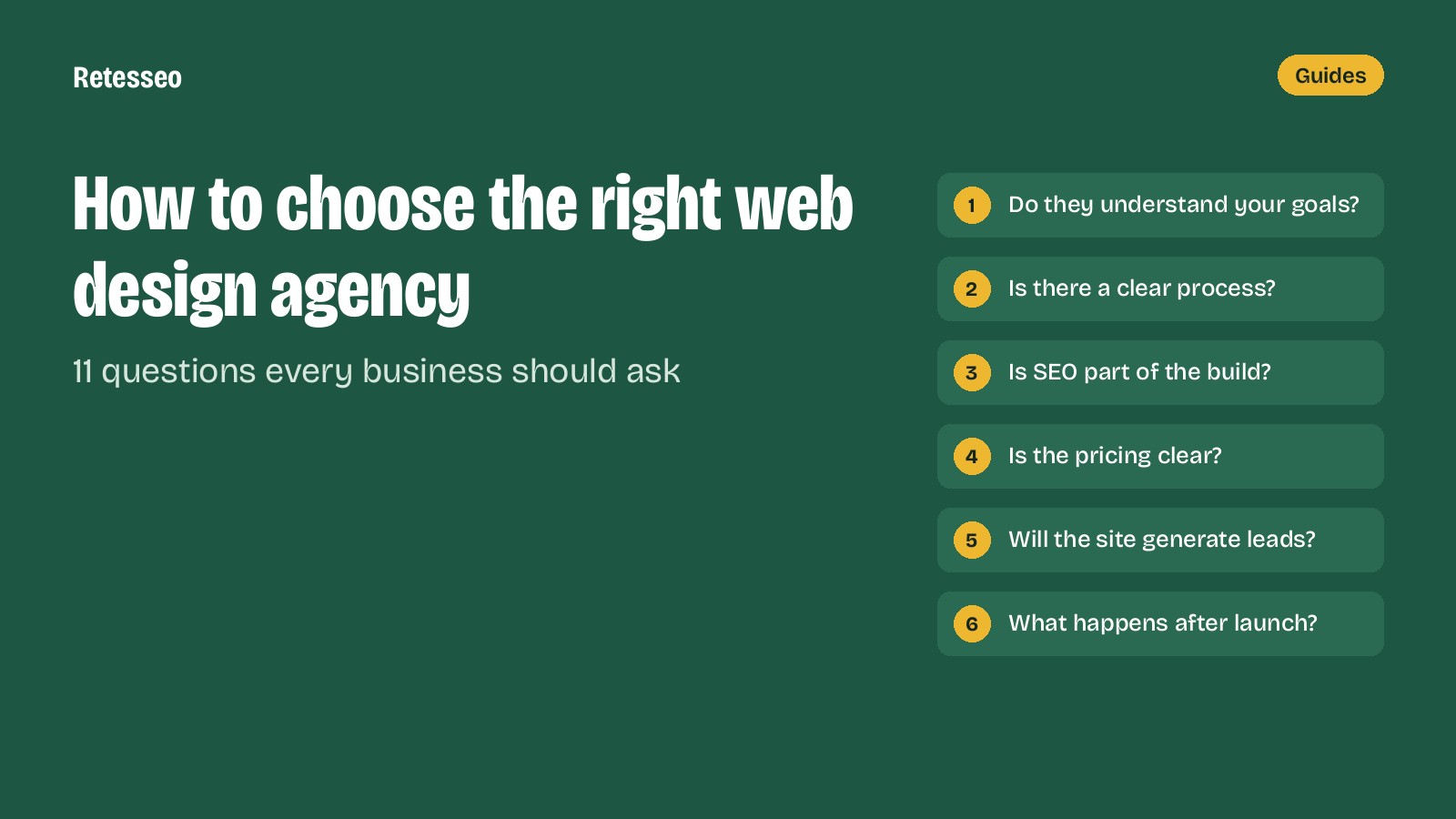
The 11 questions at a glance
- Do they understand your business goals?
- Do they have a clear website development process?
- Do they take time to understand your business?
- Do they focus on user experience?
- Is SEO considered during development?
- Are there hidden costs or unclear pricing?
- Do they build websites that generate leads?
- Can the website grow with your business?
- Do they use analytics and insights?
- What support is available after launch?
- Are they good value rather than just cheap?
1. Do They Understand Your Business Goals?
A website should be built around business objectives, not just design preferences. Before talking about colours and layouts, a good web design company will ask what the website needs to achieve. For most businesses that is one or more of:
- Lead generation: phone calls, contact forms and quote requests
- Sales: products or services bought online
- Bookings: consultations, appointments or viewings
- Brand awareness: being known and remembered in your market
- Customer trust: reassuring people who are comparing you with competitors
Agreeing what success looks like at the start shapes every decision that follows, from which pages you need to where the calls to action sit. If an agency can’t tell you how they will judge whether the project worked, that is worth noting.
2. Do They Have a Clear Website Development Process?
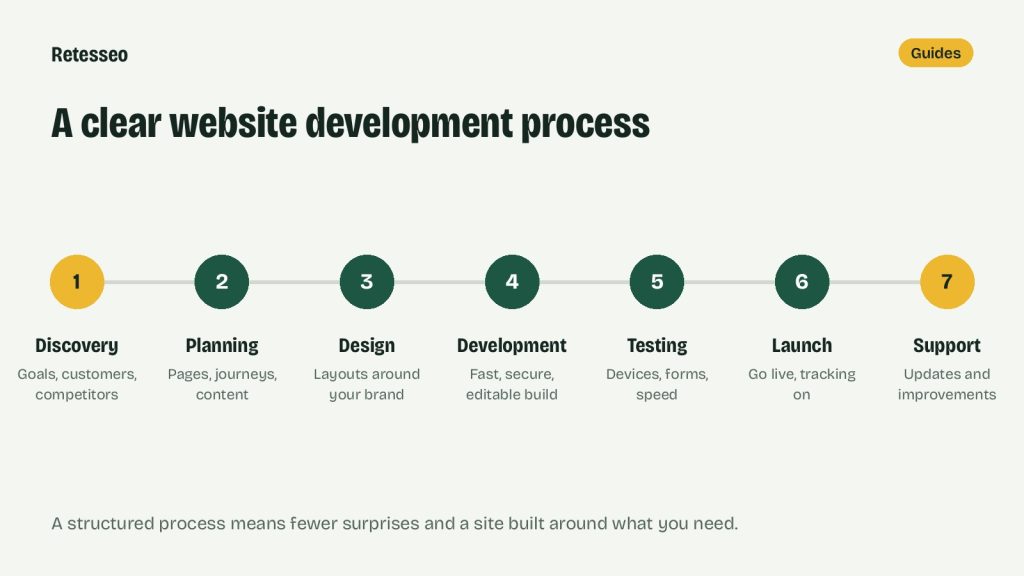
Ask the agency to walk you through how a project runs. A professional website development agency should be able to describe each stage and what you will see at the end of it:
- Discovery: your goals, customers, competitors and what is and isn’t working today
- Planning: the pages, the journey through the site and the content each page needs
- Design: layouts built around your brand, reviewed with you before any build starts
- Development: a fast, secure site that you can update yourself
- Testing: phones, tablets and browsers, forms, speed and links
- Launch: going live with tracking in place and nothing broken in the switch-over
- Support: updates, fixes and improvements after launch
A structured process reduces mistakes, avoids expensive changes late in the project and makes it much easier to keep to the timescale and budget you agreed.
3. Do They Take Time to Understand Your Business?
Every business has different customers and different challenges. A website for a law firm needs a different approach from one for a property developer or an online shop: the questions visitors arrive with, the level of reassurance they need and the action you want them to take are not the same. A good agency will want to understand your:
- Industry and how buyers in it make decisions
- Target audience and their main concerns
- Products and services, and which matter most
- Customer journey from first search to first conversation
- Competitors and how you compare
- Business goals for the next few years
Questions a good agency should ask you
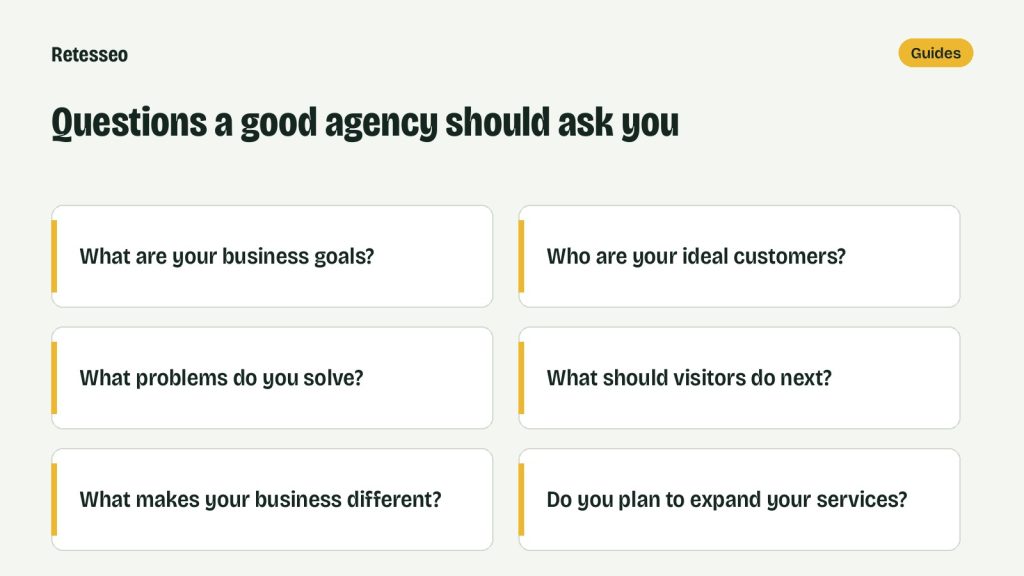
- What are your business goals?
- Who are your ideal customers?
- What problems do you solve for them?
- What action should visitors take on the website?
- What makes your business different?
- Do you plan to expand your services?
If an agency moves straight to templates and colour choices without asking questions like these, the result may look good but is unlikely to perform well. Strong websites are built around business strategy, not just visual design.
4. Do They Focus on User Experience?
An attractive website is not enough on its own. User experience is about how easily people find what they need and take the next step. Look at the agency’s previous work on your phone as well as a laptop, and check for:
- Easy navigation: clear menus and obvious routes to key pages
- Mobile responsiveness: layouts that work properly on any screen size
- Clear messaging: plain language rather than vague slogans
- Fast loading times: pages that appear quickly, even on mobile data
- Simple customer journeys: as few steps as possible between interest and enquiry
Within a few seconds of arriving, a visitor should understand who you are, what you offer, why they should trust you and how to contact you. If the agency’s own website and portfolio don’t pass that test, it is a useful signal.
5. Is SEO Considered During Development?
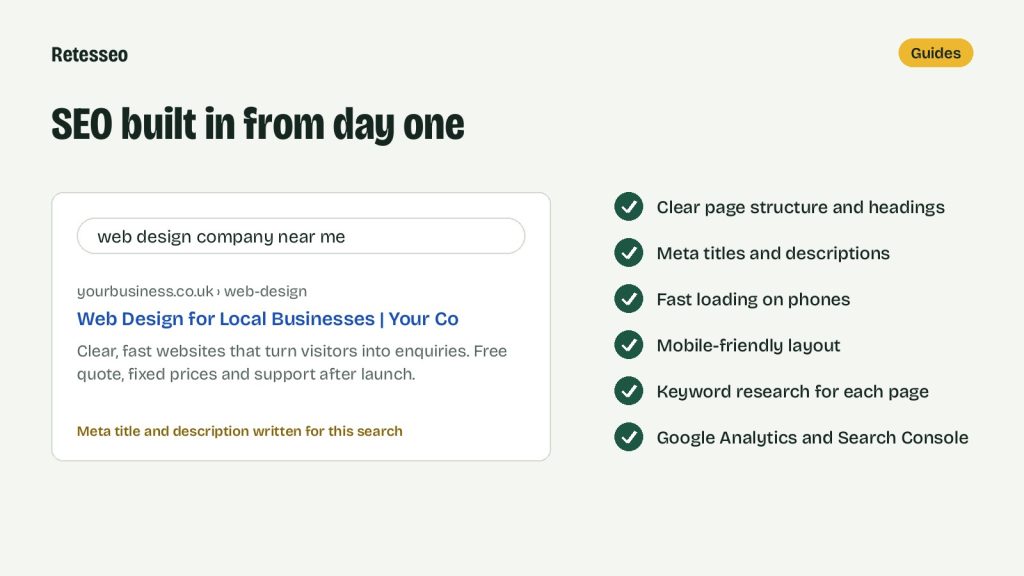
Search engine optimisation should not be added as an afterthought. Many of the things that help a site rank are decided while it is being built, and they are far cheaper to get right first time than to fix later. Ask how the agency handles:
- Technical SEO: clean code, correct redirects, a sitemap and no broken links
- Website structure: a page for each important service or location
- Page speed and mobile optimisation
- Metadata: page titles and descriptions written for real searches
- Internal linking between related pages
- Search visibility after launch, through Google Search Console
At Retesseo, SEO foundations are part of every build, and ongoing SEO sits within our digital marketing services for businesses that want to keep growing their search visibility after launch.
6. Are There Hidden Costs or Unclear Pricing?
Transparency matters. Two quotes can look similar until you discover that one includes hosting, content and support while the other charges separately for each. Before you sign anything, make sure you know who pays for:
- Hosting and the SSL certificate
- Maintenance, security and software updates
- The domain name, and who owns it
- Content changes after launch
- Additional features added later
- Ongoing support and how quickly it responds
You should understand exactly what is included before work starts, and you should own your website and domain. At Retesseo, we publish our website development packages and explain where your investment goes, so there are no surprises later.
7. Do They Build Websites That Generate Leads?
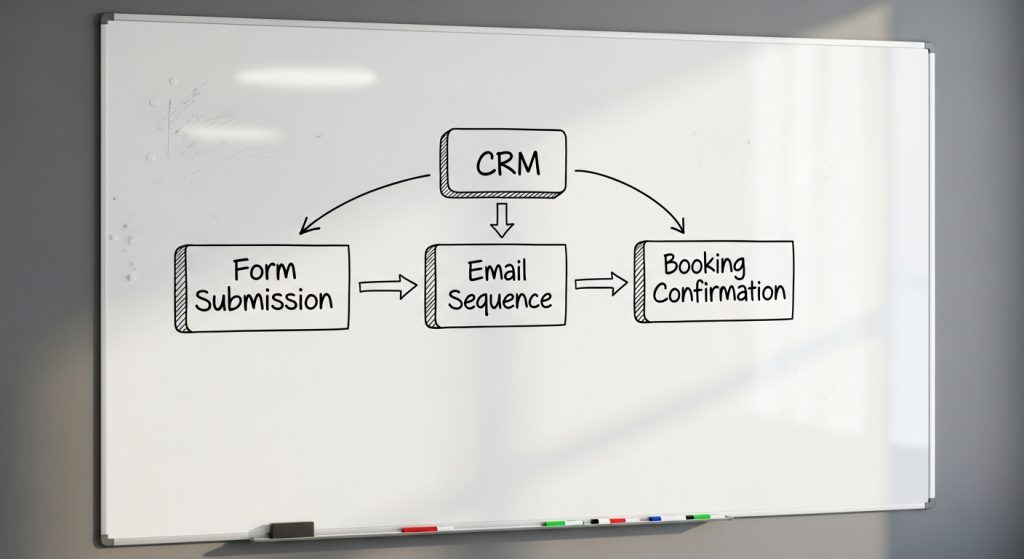
A website should contribute to business growth. That means it is designed as a business tool rather than an online brochure, with:
- Clear calls to action on every key page
- Contact forms that are short, work on phones and reach the right person
- Landing pages for campaigns and adverts, each with one clear goal
- Conversion-focused design that puts reassurance next to the decision
- Customer journeys that lead naturally from a question to an enquiry
Ask the agency how lead generation is built into their sites, and what happens to an enquiry once it is sent: whether it lands in your inbox, your CRM or a booking system.
8. Can the Website Grow With Your Business?
Your website should be able to keep up as the business changes. Find out how easy it will be to:
- Add new services or locations
- Create new pages without paying a developer each time
- Integrate tools such as CRMs, booking systems or email marketing
- Expand functionality, for example client portals or online payments
- Support future marketing campaigns with new landing pages
Business website development on an established platform such as WordPress, with full admin access and no proprietary builder, generally makes growth easier and avoids being locked in to one supplier. For more complex needs, custom website development can be planned around where the business is heading, not just where it is today.
9. Do They Use Analytics and Insights?
Without data, it is hard to know whether a website is doing its job. A good agency sets up tracking at launch, including:
- Google Analytics, to see how people find and use the site
- Google Search Console, to see which searches you appear for
- User behaviour, such as which pages people read and where they leave
- Conversion tracking, so every form, call and booking is counted
- Customer actions that show what persuades people to get in touch
These analytics and insights help you make better decisions about content, advertising and future improvements, rather than relying on guesswork.
10. What Support Is Available After Launch?
Launching the website is rarely the end. Websites need looking after, and the most useful improvements often come once real visitors are using them. Ask what the agency offers for:
- Updates to WordPress, themes and plugins
- Security monitoring and daily backups
- Improvements based on how visitors use the site
- Performance monitoring, including speed and uptime
- Future development as your needs change
Find out how support is priced, how quickly they respond and whether you can make simple changes yourself.
11. Are They Good Value Rather Than Just Cheap?
It is tempting to pick the lowest quote, but the cheapest option is not always the best value. Compare agencies on quality, strategy, communication, reliability and long-term value. A cheaper website may cost more later if it needs rebuilding within a couple of years, does not attract customers or cannot support the business as it grows.
If you are still working out a budget, our guide to the cost of website development explains typical UK prices in 2026 and what drives a quote up or down.
Freelancer vs web design agency vs DIY website builder
| Freelancer | Web design agency | DIY website builder | |
|---|---|---|---|
| Typical upfront cost | Low to medium | Medium to high | Lowest |
| Strategy and planning | Varies by individual | Usually part of the process | Up to you |
| Skills available | One person’s skill set | Design, development, SEO and marketing | Templates and your own time |
| SEO foundations | Varies | Usually included | Basic settings only |
| Support after launch | Depends on availability | Ongoing plans and a team | Platform help centre |
| Flexibility | Good | High, including custom development | Limited to the platform |
| Best for | Smaller, well-defined projects | Websites that need to generate leads and grow | Very small budgets and simple sites |
Frequently Asked Questions
How much does a professional website cost?
In the UK in 2026, a basic business website typically costs £500–£2,000, a professional business website £2,000–£10,000, and custom website development £10,000 or more. The final price depends on design, the number of pages, functionality, content and SEO. Retesseo website builds start from £350.
How long does website development take?
A template-based website can be ready in one to three weeks. A professional custom website usually takes four to eight weeks, and complex projects with integrations can take three months or more. Having content ready early is the biggest factor in keeping to schedule.
Should I hire a freelancer or a web design agency?
A freelancer can be a good fit for a smaller, clearly defined project. A web design agency brings design, development, SEO and marketing skills together and can offer ongoing support, which suits businesses that need their website to generate leads and grow.
What should be included in a website development package?
At a minimum: a set number of pages, responsive design, contact forms, basic SEO and mobile optimisation. Higher packages add custom design, conversion-focused pages, analytics and conversion tracking, integrations and ongoing support. Check whether hosting, content and the domain are included.
How can a website help my business grow?
A website helps a business grow when it is easy to find on Google, explains clearly what you do, builds trust and makes it simple to get in touch. Combined with SEO, content and advertising, and measured with analytics, it becomes a steady source of enquiries.
Conclusion: Choose a Partner, Not Just a Supplier
Choosing the right web design agency is about finding a partner who understands your business, your customers and your goals. The best results come when design, technology, user experience, SEO and marketing strategy are planned together from the start, which is where digital marketing and website development work best as one job.
Use the 11 questions above when you speak to agencies, and pay attention to the questions they ask you in return. Whether you are comparing local web development companies or a specialist B2B web agency for B2B website development, the right partner will be clear about what they will deliver, what it costs and how it will help your business grow.
You can see how we approach projects like this on our web design & development page.
Looking for a website designed around your business goals? Contact Retesseo to discuss how we can help create a website built for growth.