

A single implant patient can be worth more to a private practice than a year of check-ups. A single tooth with a crown typically costs around £2,000 to £3,500 privately in the UK, and full-arch treatment can run well into five figures per jaw. Add the hygiene visits, maintenance and family referrals that follow, and one well-placed enquiry can be worth £5,000 or more over its lifetime.
That’s why implant enquiries are some of the most fought-over in local search. Corporate groups, specialist referral clinics and the independent practice down the road are all bidding for the same people, often on the same keywords.
The good news is that implant patients behave predictably. They search, they read, they compare and they look for reassurance. The practices that win most of the cases are rarely the cheapest. They are the ones that show up when patients search, answer their questions honestly, and make the next step easy.
The short answer: to get more dental implant patients, build a dedicated implant page that answers cost, process and risk questions clearly; make your Google Business Profile and reviews work for implant searches; use Google Ads to capture people ready to book now; follow up every enquiry quickly; and keep every claim inside GDC and ASA rules. This guide covers each step, in plain English, for UK private and mixed practices.
1. Understand How Implant Patients Choose a Practice
Implants are a considered purchase, more like a kitchen extension than a filling. Most patients take weeks or months to decide, and they usually move through the same stages:
| Stage | What they search or do | What they need from you |
|---|---|---|
| Researching | “dental implants cost UK”, “implant vs bridge”, “does it hurt” | Honest, clear answers to their questions |
| Shortlisting | “dental implants near me”, “dental implants [town]” | To appear on Google Maps and in search, with strong reviews |
| Comparing | Reads your implant page, reviews, team bios and prices | Proof: real cases, qualifications, price guide, finance |
| Deciding | Books a consultation or calls | A fast, easy way to book and a quick reply |
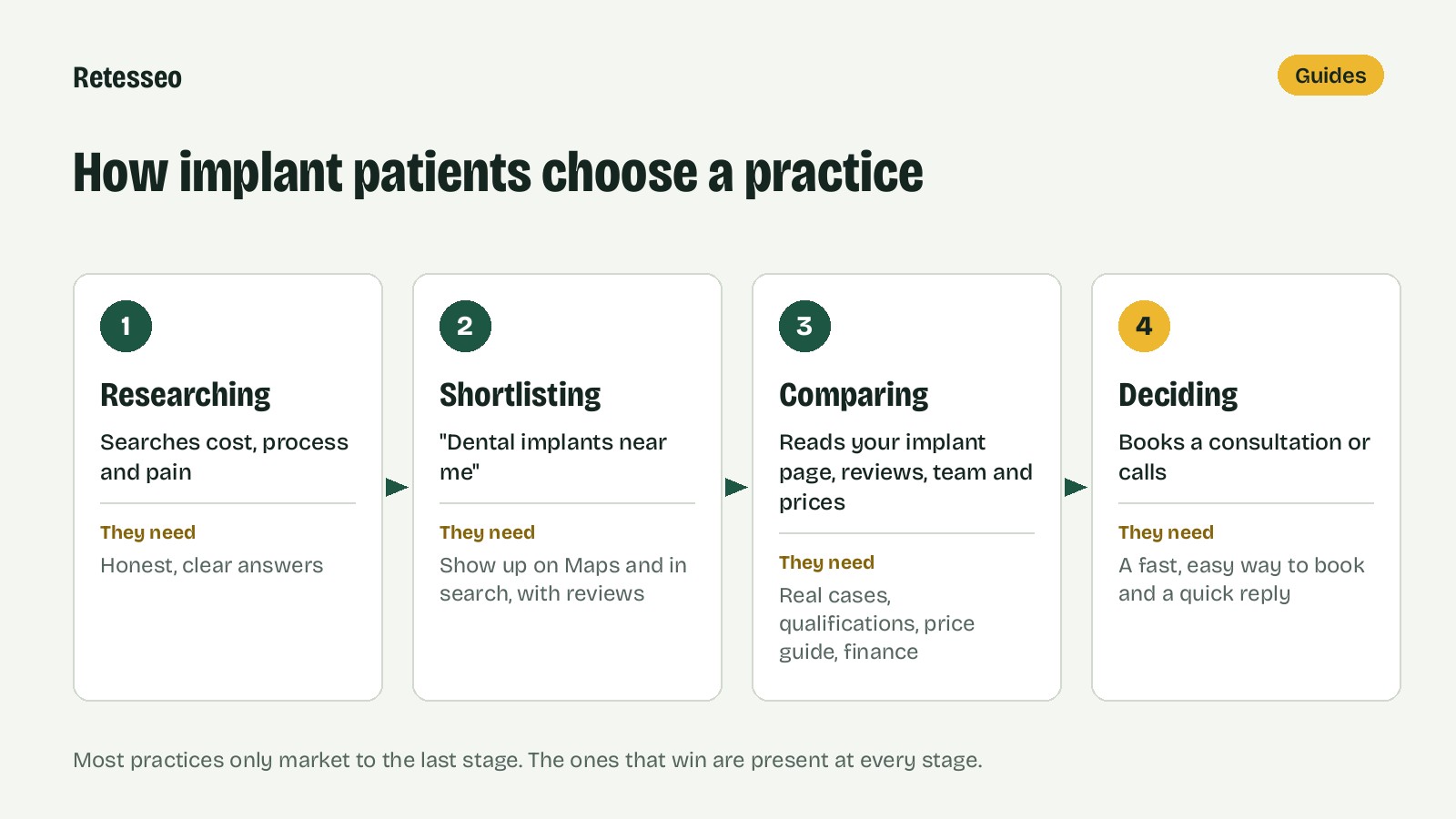
Most practices only market to the last stage. They run an ad, send it to the home page and hope. The practices that win more cases are present at every stage, so by the time a patient books, they’ve already chosen.
The biggest worries implant patients have are cost, pain, how long it takes, whether it will work, and whether they can trust the person doing it. Every part of your marketing should answer at least one of them.
2. Build a Dental Implant Page That Turns Visitors into Consultations
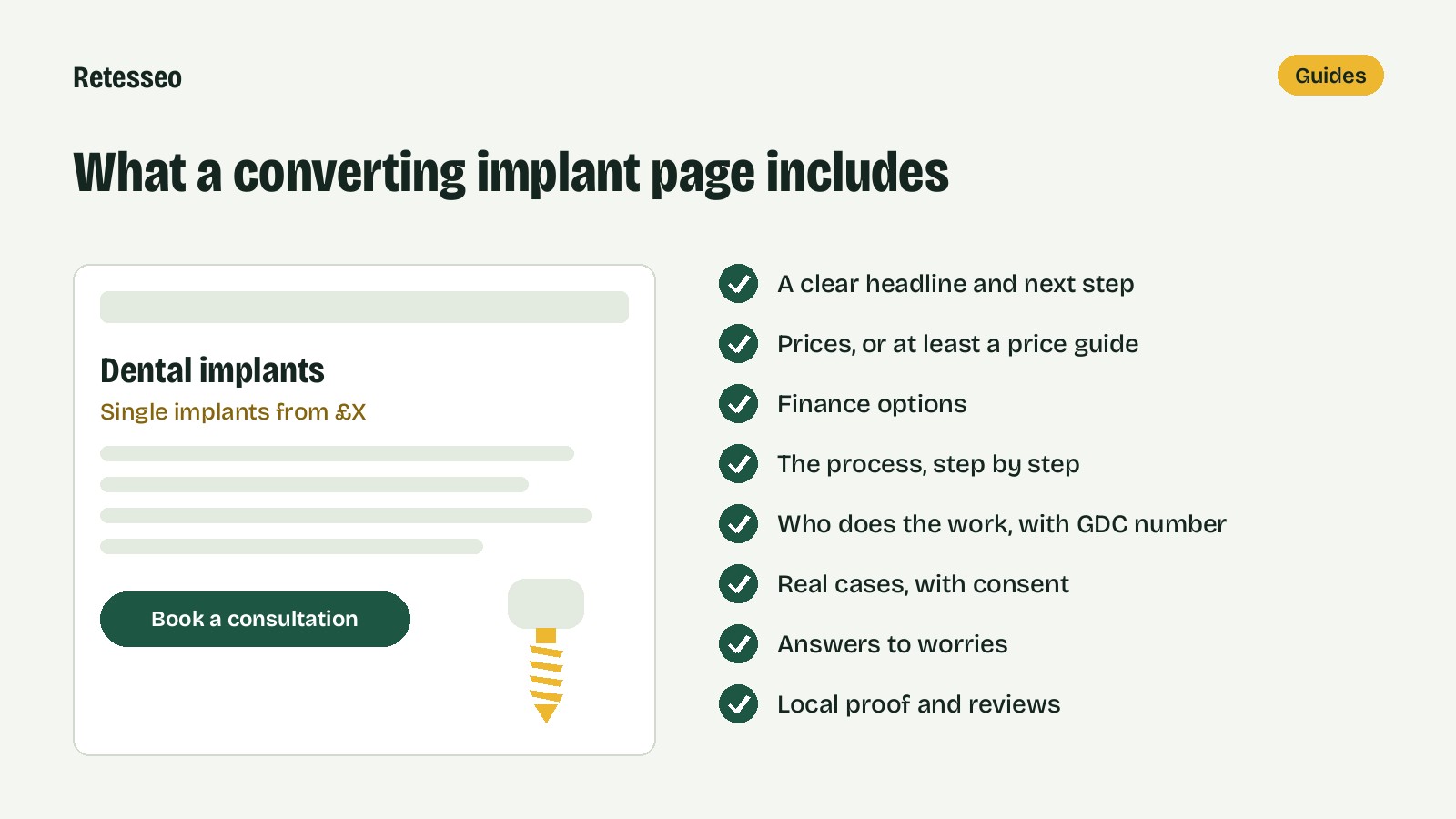
Your implant page is where most cases are won or lost. A line on a “Treatments” page, or a stock photo with three sentences, won’t persuade someone about to spend £3,000. A page that converts implant enquiries should include:
- A clear headline and next step: what you offer, where, and a “Book an implant consultation” button visible without scrolling, plus tap-to-call on mobile.
- Prices, or at least a price guide: “single implants from £X” and what’s included (assessment, scan, implant, abutment, crown). Patients compare quotes, and many leave pages that hide the cost.
- Finance: typical monthly payments over 12 to 36 months, using your finance provider’s approved wording.
- The process, step by step: consultation, scan, placement, healing, crown, with realistic timescales (often three to six months for a single tooth).
- Who does the work: the clinician’s name, photo, qualifications, GDC number and implant experience in plain numbers, such as years placing implants and cases completed.
- Real cases: genuine before-and-after photos and patient stories, used with signed consent.
- Answers to worries: pain, sedation options, success rates, aftercare, guarantees, and what happens if something goes wrong.
- Local proof: reviews that mention implants, your address, parking and the areas patients travel from.
If you offer several implant treatments, give each its own page: single implants, multiple teeth, implant-retained dentures, and same-day or full-arch treatment. Each one targets different searches and different budgets.
Practical tip: put your price guide and “what’s included” on the page itself, not in a downloadable PDF. Patients want the answer straight away, and Google can’t read a price buried in an attachment as easily as text on the page.
Our guide to website development costs explains what it costs to build pages like these properly.
3. Get Found for “Dental Implants Near Me” on Google Maps and Search
When a patient is ready to shortlist, they search locally. The practices pinned on the map and listed at the top of the page get most of the calls. To show up for implant searches in your area:
- Complete your Google Business Profile. Choose “Dentist” or the most accurate category, add “Dental implants” and each implant treatment as services, and write a description that mentions implants and the areas you serve.
- Ask implant patients for reviews. A review that mentions implants, sedation or the clinician by name tells future patients, and Google, that you do this work. Ask at the final crown appointment, when patients are happiest.
- Add real photos. Show your surgery, scanner, team and treatment rooms. Patients spending thousands want to see where they’ll be treated.
- Post regularly. Short Google Business Profile updates about implant consultations, finance or new technology keep the listing active.
- Create location pages carefully. If patients travel to you from nearby towns, a genuinely useful page for each one can help, as long as it isn’t the same text with the town name swapped.
- Write content that answers questions. Articles such as “how much do dental implants cost in [town]” or “implants vs dentures” capture patients at the research stage and lead them to your implant page.
If your practice doesn’t appear on the map at all, work through our guide to why your business isn’t showing up on Google Maps first.
SEO for implants is competitive, so expect it to take months rather than weeks. It is also the channel that keeps bringing in enquiries without paying for every click, which is why the strongest practices invest in it continuously.
4. Use Google Ads to Reach Patients Ready to Book Now
SEO builds over months. Google Ads puts you in front of people searching for implants today. Because each case is worth so much, implant ads can pay for themselves many times over, but they’re also among the easiest campaigns to waste money on.
What works:
- Specific, high-intent keywords such as “dental implants [town]”, “single tooth implant cost” or “implant dentist near me”, rather than broad terms like “dentist”.
- Negative keywords to filter out people you can’t help: “NHS”, “free”, “Turkey”, “cheap abroad”, “jobs”, “course”.
- A dedicated landing page for each campaign, never your home page, with the price guide, finance, reviews and a booking form above the fold.
- A sensible radius. Most implant patients will travel further than for a check-up, but not across the country. Start with the area your existing implant patients come from.
- Call and form tracking, so you know which keywords bring in consultations, not just clicks.
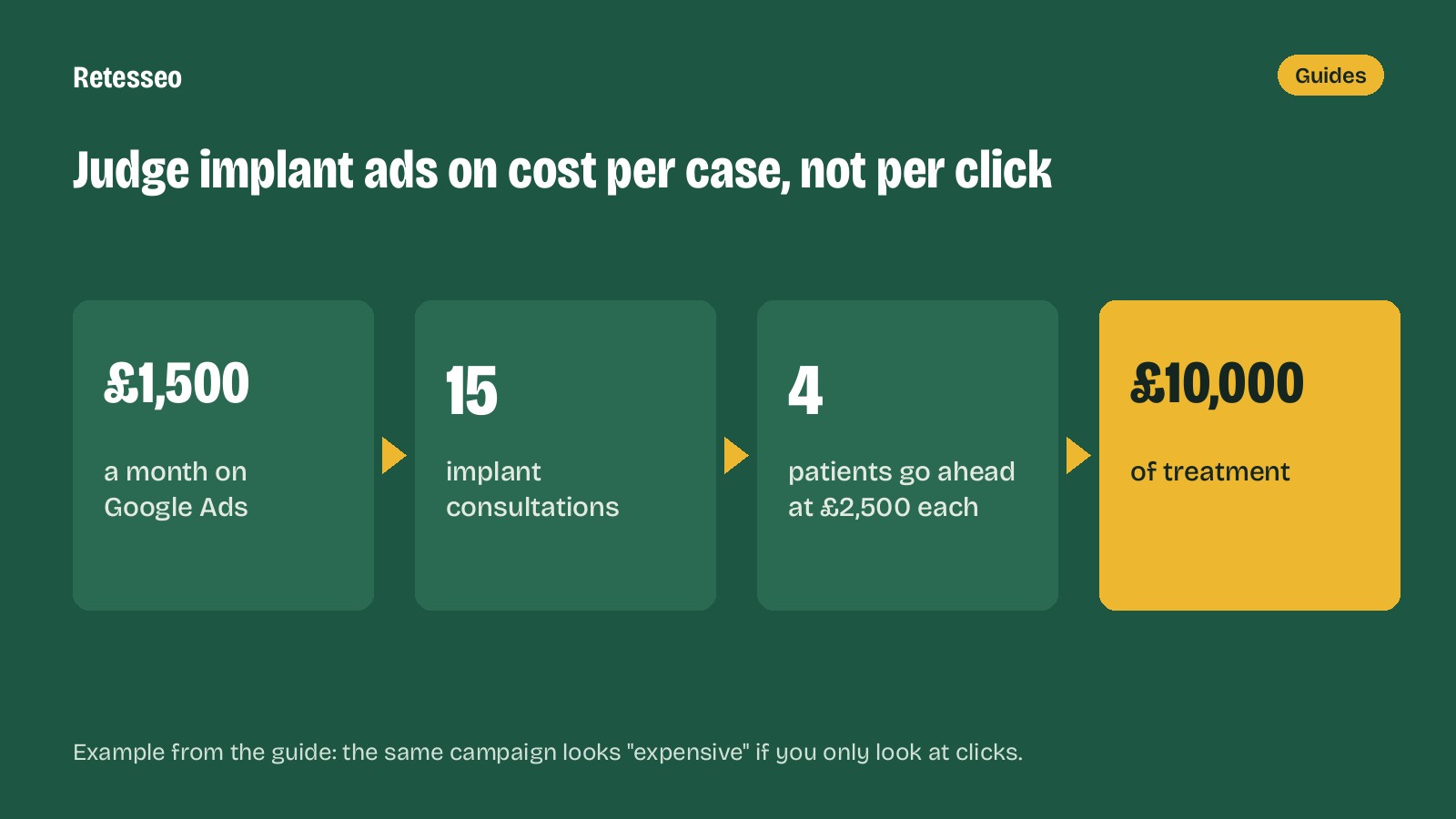
How to judge it: don’t measure implant ads on cost per click. Measure them on cost per consultation and cost per case. For example, if a campaign costs £1,500 a month, produces 15 consultations and four patients go ahead at £2,500 each, that’s £10,000 of treatment for £1,500 of ads. The same campaign would look “expensive” if you only looked at clicks.
New to advertising on Google? Our beginner’s guide to Google Ads explains how it works and why campaigns fail.
Don’t let enquiries go cold. An implant enquiry answered within the hour is far more likely to book than one answered the next day, when the patient may already have spoken to two other practices. Make sure someone owns every form and missed call, and follow up patients who attended a consultation but haven’t decided yet.
5. Stay Inside the GDC and ASA Advertising Rules
Dental marketing is regulated, and implant marketing is where practices most often get it wrong. Misleading advertising can lead to an ASA ruling, a complaint to the General Dental Council or, in serious cases, a fitness to practise investigation. The main rules to know:
| Rule | What it means for your marketing |
|---|---|
| Only dentists on a GDC specialist list can call themselves a “specialist” | There’s no GDC specialist list for implantology, so avoid “implant specialist” or “specialist implant centre”. Use “implant dentist” and describe experience in facts instead. |
| Your website must show key practice and clinician details | Include the practice name, address and contact details, and for each dental professional named, their qualification, the country it came from and their GDC registration number. Make clear whether you’re NHS, mixed or private. |
| Claims must be accurate and backed by evidence | Avoid “the best implant dentist in London”, “pain-free guaranteed” or success rates you can’t prove. |
| Before-and-after photos must be genuine and representative | Keep signed, dated consent and proof for every image, don’t edit them beyond basic cropping or lighting, and don’t show only your most dramatic case as typical. |
| Don’t compare your team’s skills with other professionals | Talk about your own experience and results, not why other dentists are worse. |
| Prescription-only medicines can’t be advertised to the public | If you also offer facial aesthetics, don’t name botulinum toxin in ads. Promote a consultation instead. |
Done well, compliance becomes a selling point. A clinician’s GDC number, real qualifications and genuine patient cases are exactly the reassurance an implant patient is looking for.
This section is a practical summary, not legal advice. Check the GDC’s guidance on advertising and the ASA’s advice for dental advertisers, or speak to your indemnity provider if you’re unsure.
How Retesseo Helps Private Dental Practices
Many practices pay separate suppliers for the website, SEO and ads, and none of them can say how many implant cases came from last month’s spend. We run all of it as one team and track every enquiry to the channel that brought it in.
For dental practices, that typically includes:
- Implant and treatment pages built to convert, with price guides, finance, clinician profiles and compliant case studies
- Local SEO and Google Business Profile management for implant, Invisalign and cosmetic searches in your area
- Google Ads for high-intent implant searches, with negative keywords and dedicated landing pages
- Content that answers the questions patients ask before they book
- Enquiry tracking and follow-up, so you see the cost per consultation and per case, not just clicks
Our Dominate and Command plans, from £349 and £699 a month, are built for practices that want to pull ahead of local competitors. For a practice where one implant case is worth around £2,500, a single extra case a month covers the plan several times over.
We won’t promise a number-one position or a set number of cases; nobody honestly can. We’ll show you where your implant enquiries are coming from, where money is being wasted, and what to fix first.
Want to see what this looks like in practice? Our concept dental clinic website shows a dedicated implants page, online booking up front and NHS and private prices in one table. The practice is fictional; the ideas are the ones we use for real clinics.
Frequently Asked Questions
How do I get more dental implant patients?
Create a dedicated implant page with a price guide, finance options, the treatment process and clinician details. Then make sure patients can find it through Google Maps, search and targeted Google Ads, and respond to every enquiry quickly. Reviews from implant patients and genuine case studies help patients choose you.
What is the best marketing for dental implants?
There’s no single channel. Google Ads brings in patients searching now, SEO and Google Business Profile build steady enquiries over time, and a strong implant page turns both into consultations. Practices that track cost per case can move budget to whatever works best.
How much should a practice spend on implant marketing?
It depends on your area, competition and capacity. Start from the value of a case: if one implant patient is worth around £2,500, you can afford to spend a meaningful share of that to win them, as long as you’re tracking which spend produces consultations and cases.
Can a dentist advertise as an implant specialist?
No. Only dentists on a GDC specialist list can use the title “specialist”, and there’s no specialist list for implantology. Describe your experience factually instead, such as years placing implants and cases completed.
Can dental practices use before-and-after photos?
Yes, if the photos are genuine, representative of typical results, not digitally altered, and you hold signed, dated consent and proof from the patient.
Should I show implant prices on my website?
In most cases, yes. Patients compare costs before booking, and a clear price guide with what’s included builds trust and filters out enquiries that were never going to proceed.
How long does dental SEO take to work?
For competitive implant searches, expect several months before you see a steady rise in enquiries. Google Ads can bring in enquiries straight away while your organic visibility builds.
Conclusion: Win the Patient Before They Book
Implant patients don’t choose on price alone. They choose the practice that showed up when they searched, answered their questions honestly, proved it could do the work, and made booking easy.
Start with the page: a dedicated implant page with prices, finance, the process and your clinician’s credentials. Then make sure patients can find it, through Google Maps, search and well-targeted ads, and that every enquiry gets a fast reply. Keep every claim inside GDC and ASA rules, and let your real cases and reviews do the persuading.
If you’d like to know how many implant enquiries your practice is missing, and what each one is costing you, get a free audit or book a free call with Retesseo.