

Most people now start looking for a service the same way: they open Google and type what they need. “Accountant near me”, “builder for house extension”, “commercial property solicitor London”.
If your business isn’t there at that moment, the enquiry goes to someone who is. That is the problem Google Ads solves. It lets you put your business in front of people who are actively searching for what you offer, in the places you serve, on the day they are ready to get in touch.
This guide explains how advertising on Google works in plain English: what Google Ads are, how to set up a campaign that brings in real enquiries, what it costs, the mistakes that waste most budgets, and when it makes sense to bring in a Google Ads agency.
What Are Google Ads?
Google Ads are paid adverts that appear in Google search results, usually above and below the normal listings and marked “Sponsored”. Businesses choose the searches (keywords) they want to appear for, write a short ad, set a budget, and pay only when someone clicks through to their website or taps to call.
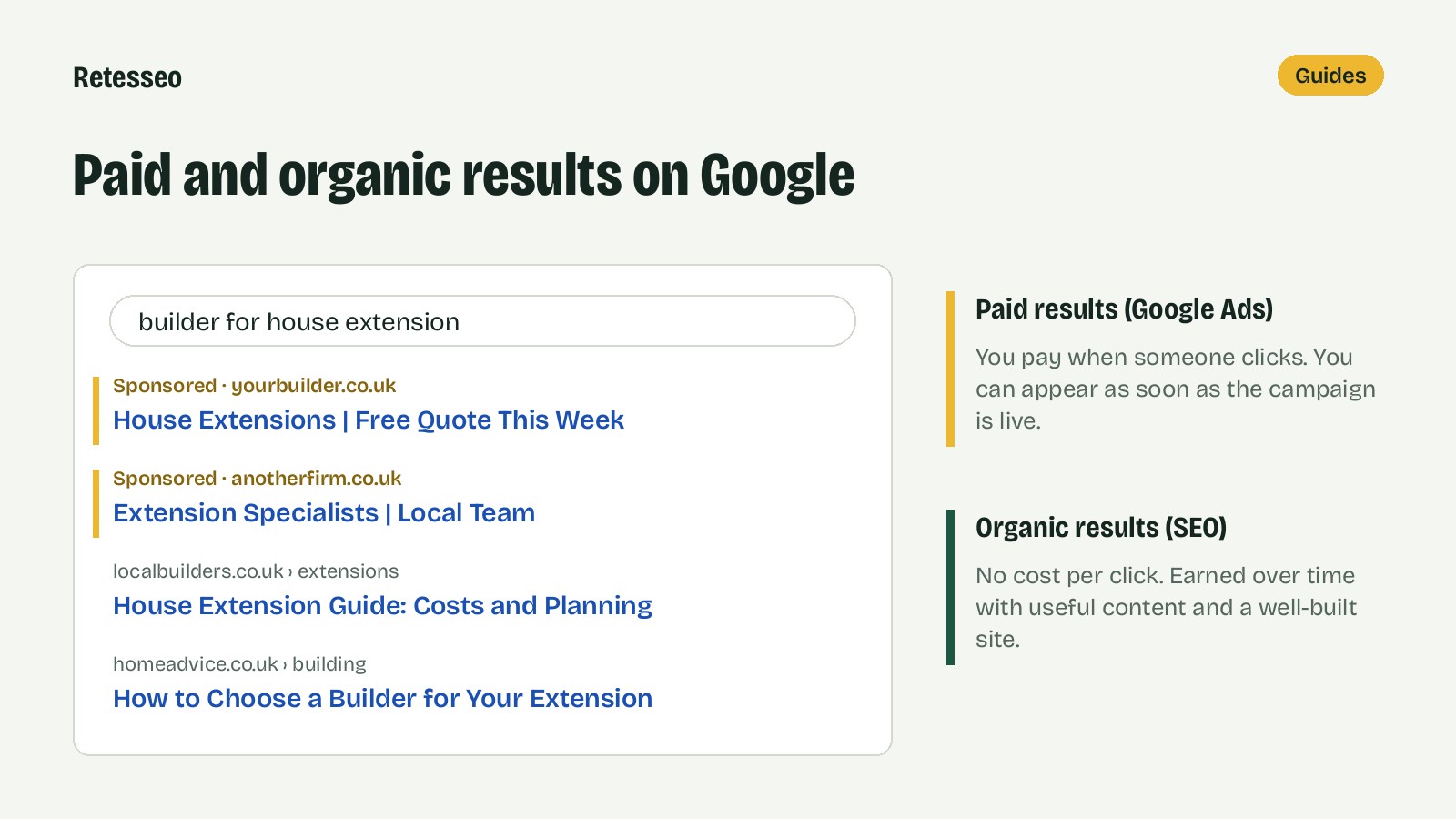
Organic results vs paid results
There are two ways to appear on Google search results:
- Organic results (SEO): the normal listings. You can’t pay to be in them; you earn a place over time by having a well-built website with useful content that Google trusts. Clicks are free, but results take months.
- Paid results (Google Ads): the sponsored listings. You pay for each click, but you can appear as soon as a campaign is approved, for exactly the searches and areas you choose.
How Can Google Ads Help Your Business?
Reach customers who are already searching
Most advertising interrupts people who weren’t thinking about you. Search advertising is different: it answers a question someone has just asked. A person searching “solicitor near me” or “emergency roofer Croydon” has a need right now, which makes them far more likely to get in touch than someone scrolling past an advert on social media. This is called search intent, and it is the main reason Google advertising for businesses works so well when it is set up properly.
Generate more website visitors
Google Ads sends targeted traffic to your website: people from the areas you serve, searching for the services you sell, at the times you choose. For a new website, or one that doesn’t yet rank well, it is one of the quickest ways to increase business visibility online.
Increase enquiries
Visitors are only useful if they turn into customers. A well-run campaign is built around the actions that matter to your business:
- Phone calls, including calls straight from the ad on a mobile
- Contact form submissions
- Online bookings and appointments
- Quote and callback requests
Test marketing ideas quickly
Because ads go live within days and results are measured from the first click, Google Ads is also a fast way to learn what your market wants. You can test:
- Which services attract the most interest
- Which offers or messages people respond to
- Which locations bring in the best customers
- Which keywords lead to enquiries rather than browsing
How to Advertise Your Business on Google
If you’re wondering how to advertise your business on Google, the process comes down to four steps. Getting each one right matters more than the size of your budget.
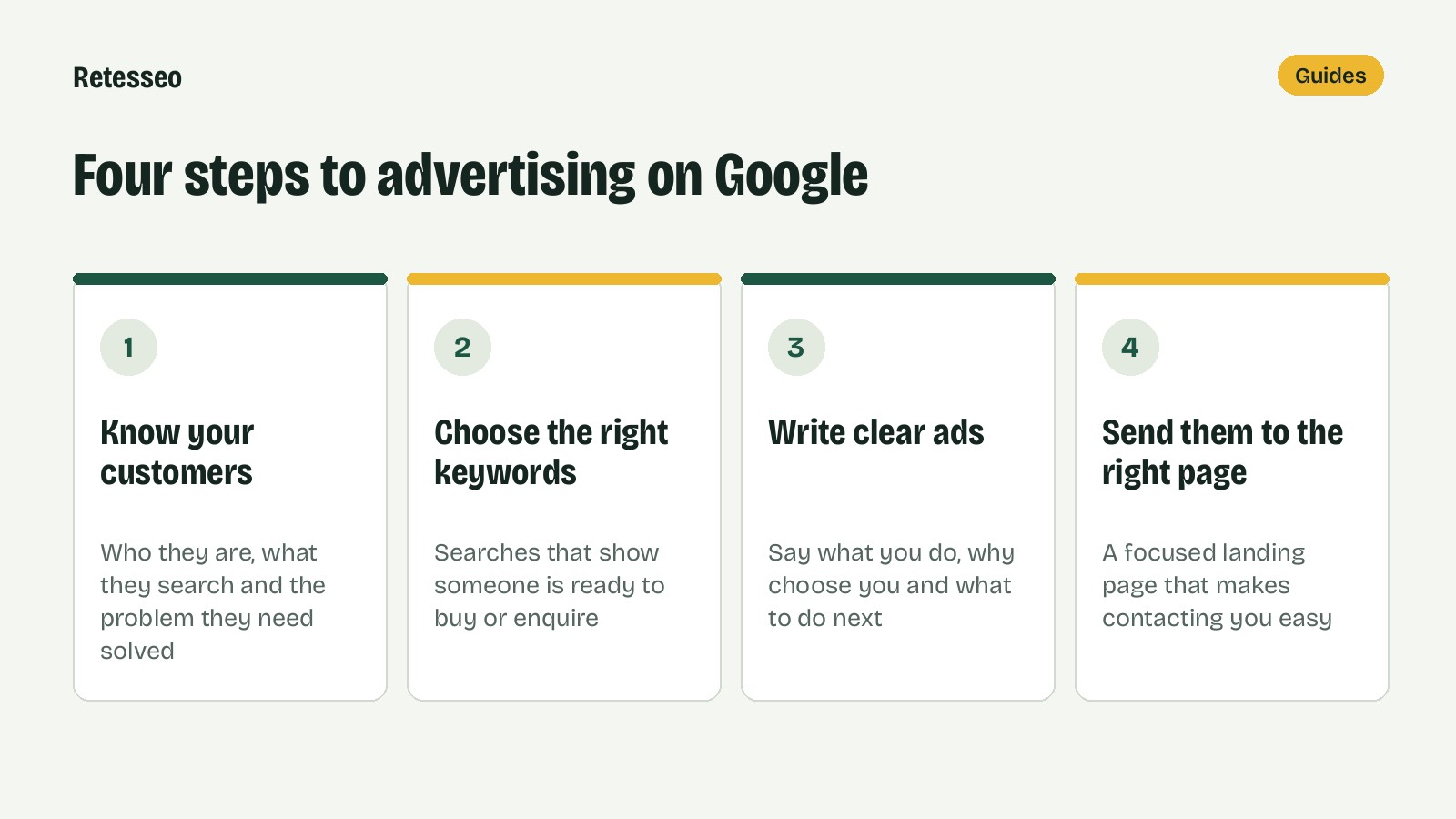
1. Understand your customers
Start with the people you want to reach, not with Google. Write down:
- Who they are: homeowners, landlords, finance directors, other businesses?
- What they search: the words customers actually use, which are often different from industry terms
- Their problems: what has gone wrong or what they want to achieve when they reach for their phone
- Where they are: the towns, postcodes or regions you can genuinely serve
2. Choose the right keywords
Good keywords match buying intent. Compare these two searches:
| Search | What the person probably wants | Good for ads? |
|---|---|---|
| website designer London | To hire someone, soon | Yes: clear intent to buy |
| what is web design | To learn, not to buy | Usually no: better covered by an article |
Focus your budget on searches that show someone is ready to act, often including words like “near me”, a location, “quote”, “cost” or “hire”. Just as important are negative keywords: searches you tell Google never to show your ads for, such as “jobs”, “free”, “course” or “DIY”. They stop money leaking away on clicks that were never going to become customers.
3. Create effective ads
A Google search ad is short, so every word has to earn its place. Strong ads usually have:
- Clear messaging that repeats what the person searched for, so they know straight away it’s relevant
- A benefit that sets you apart: fixed prices, same-week appointments, accredited, local team, years of experience
- A strong call to action: “Get a free quote”, “Book a consultation”, “Call today”
- Extras such as your phone number, location, reviews and links to specific services, which make the ad bigger and more useful
4. Send visitors to the right page
Where the ad sends people matters as much as the ad itself. Someone who clicks an ad for “loft conversions in Bristol” should land on a page about loft conversions in Bristol, not your home page. A good landing page has:
- Relevant content that matches the ad and answers the obvious questions
- Clear contact options: a visible phone number, a short form and a button that stays in reach on mobile
- Trust signals: reviews, accreditations, photos of real work, and the people behind the business
Why Google Ads Campaigns Often Fail
Plenty of business owners try Google Ads once, spend a few hundred pounds, get little back and decide it doesn’t work. Usually the platform wasn’t the problem. These are the most common reasons campaigns fail.
Targeting the wrong searches
Broad keyword settings and no negative keywords mean ads appear for loosely related searches. The clicks look busy in reports, but they come from people looking for jobs, free advice or a different service entirely.
Sending traffic to poor websites
A slow, dated or confusing website wastes every click you pay for. If visitors can’t quickly see what you do and how to contact you, they press back and choose the next result.
Not tracking results
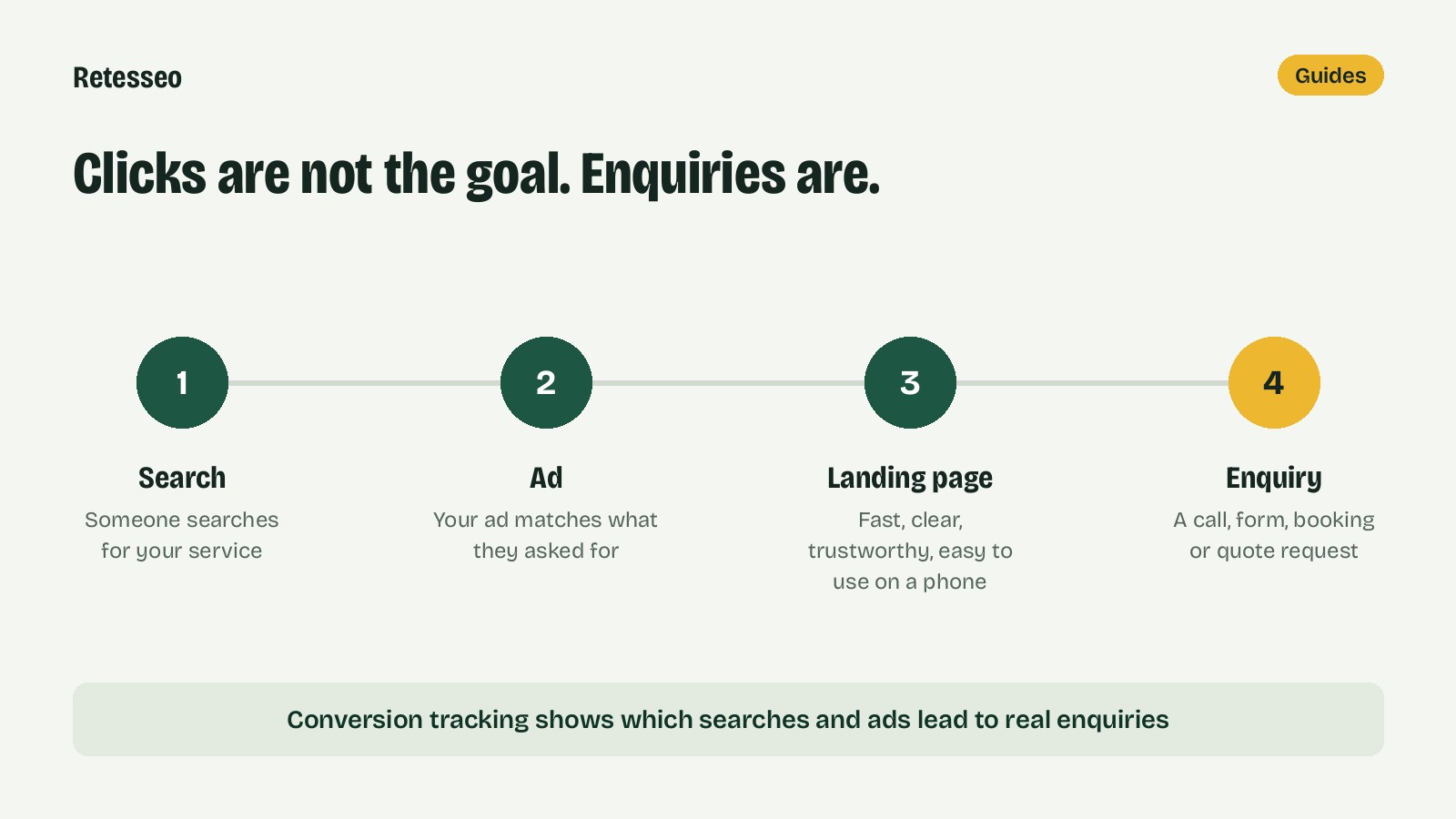
Without conversion tracking you can’t tell which keywords bring enquiries and which just spend money. Decisions get made on clicks and impressions, which are easy to increase but don’t pay the bills.
Spending without a strategy
Switching ads on without clear goals, a sensible budget, a defined area or a plan for reviewing results is like opening a shop without deciding what to sell.
Ignoring mobile users
Many local searches happen on phones. If your page is hard to use on a small screen, your phone number isn’t tappable, or forms are long and fiddly, a large share of your paid visitors will leave without getting in touch.
The common thread: advertising isn’t about getting clicks, it’s about generating valuable customer enquiries. Every part of the campaign should be judged on that.
How Much Does Google Ads Cost?
There is no fixed price for Google Ads. You set your own budget and pay each time someone clicks your ad. What each click costs depends on how many other businesses are bidding for the same searches, so it can range from well under £1 in quiet local markets to £20 or more in highly competitive sectors such as legal services.
The main factors are:
- Industry competition: sectors where one customer is worth a lot, like law, finance and property, attract more advertisers and higher click prices
- Keywords: specific, high-intent searches often cost more per click but convert better
- Location: large cities are usually more competitive than smaller towns
- Budget: you choose a daily budget, and Google won’t spend more than that budget on average over a month
- Customer value: what a new customer is worth to you decides how much you can afford to pay for an enquiry
A smaller business can start with a controlled budget focused on a few high-intent keywords and a tight area, then increase spend once it is clear which searches bring in work. Judge it on cost per enquiry and return on investment, not cost per click. Businesses in competitive industries usually need a larger budget to appear consistently. If you use an agency, there is normally also a management fee on top of the advertising spend itself.
Is Google Ads Worth It for Small Businesses?
Google Ads for small businesses can be very worthwhile, but it isn’t right for every business in every situation. It tends to work well when:
- Customers are actively searching for your service on Google
- Campaigns are targeted correctly to the right searches, areas and times
- Landing pages convert visitors into calls and enquiries
- Results are measured so budget moves towards what works
It is harder to make work for products nobody searches for yet, or where a single sale is worth very little. In those cases other channels, such as social media advertising or content, may be a better starting point.
Success depends on strategy, not simply spending more money. A smaller, well-run campaign often brings in more enquiries than a larger one left to run on autopilot.
Google Ads vs SEO: Which Is Better?
Both help you get your business on Google search, but they work differently:
| Google Ads | SEO | |
|---|---|---|
| Results | Faster: visible as soon as the campaign is live | Longer-term: usually builds over several months |
| Cost | Requires an ongoing advertising budget | Requires investment in content and time |
| Visibility | Paid placement, labelled “Sponsored” | Organic ranking in the normal results |
| When you stop paying | Traffic stops | Rankings usually hold for some time |
| Best for | Immediate traffic and testing | Sustainable growth and lower cost per enquiry over time |
Most businesses benefit from combining the two. Ads bring in enquiries straight away and show which keywords are worth winning; SEO builds a lasting presence for those same searches so you rely less on paid clicks over time. Together they form the core of digital marketing for small businesses that want steady growth. You can see how we bring them together on our digital marketing page.
Why Your Website Matters for Google Ads
Advertising only brings people to your website. What happens next is up to the website. Two businesses can run identical ads and get very different results, simply because one site turns visitors into enquiries and the other doesn’t.
To get the most from every click, your website needs:
- Professional design that makes a good first impression and reflects the quality of your work
- Fast loading speed, so paid visitors aren’t left waiting
- Mobile optimisation, with tappable phone numbers and short forms
- Clear calls to action on every page, so visitors always know the next step
- Trust-building content: reviews, case studies, accreditations and real photos
If your website is holding your advertising back, it is often cheaper to fix the site first than to keep paying for clicks that don’t convert. Our web design & development service builds sites around exactly this, and our guide to how much website development costs explains what to budget.
How Retesseo Helps Businesses Grow Online
As a Google Ads agency that also designs and builds websites, Retesseo treats advertising, websites and lead generation as one job, because they only work well together. Our approach:
- Understand the business: your services, customers, margins and the areas you serve
- Create targeted campaigns: high-intent keywords, negative keywords and ads written for your customers
- Improve customer journeys: landing pages and website changes that turn clicks into enquiries
- Track meaningful data: calls, forms and bookings, not just clicks and impressions
- Connect advertising with website performance: so budget moves to the channels and pages that bring in work
We aim to be a digital growth partner rather than a supplier who simply runs ads: you’ll know what is being spent, what it is producing and what we plan to do next. Find out more on our digital marketing page, or ask for a free audit of your current website and marketing.
Frequently Asked Questions
How much does Google Ads cost for a small business?
There is no fixed cost. You set your own daily budget and pay each time someone clicks your ad. Click prices depend on competition, keywords and location, ranging from well under £1 in quiet local markets to £20 or more in competitive sectors like legal services.
Is Google Ads worth it?
Google Ads is usually worth it when customers actively search for your service, campaigns target the right searches and areas, your landing pages turn visitors into enquiries, and results are tracked.
How quickly can Google Ads generate results?
Ads can start appearing within a day or two of a campaign being approved, so enquiries can begin almost straight away. It normally takes a few weeks of data and adjustments to find which keywords and ads bring in the best customers at a sensible cost.
Can Google Ads help local businesses?
Yes. Google Ads lets you show ads only to people in the towns, postcodes or radius you serve, and only at times you can respond.
Do I need a website for Google Ads?
Search ads normally send people to a page on your website, so in practice you need one. Call-only ads can work without a full site, but a fast, mobile-friendly website with clear contact options will turn far more of your paid clicks into enquiries.
Should I hire a Google Ads agency?
You can run Google Ads yourself, but it takes time to learn and to manage well, and mistakes cost money. A Google Ads agency brings experience with keywords, bidding and tracking, and a good one will also improve your landing pages and report on enquiries rather than just clicks.
Conclusion: Be There When Customers Are Searching
Google Ads can help businesses reach customers at the exact moment they are searching for a solution. For many firms it is one of the quickest ways to attract more customers online and increase website enquiries.
However, successful advertising needs the right strategy, the right audience and a website designed to turn visitors into customers. Get those right and every pound you spend has a much better chance of coming back as new business.
Want to attract more customers through Google? Contact Retesseo to discuss how we can help your business grow online.